Build a software team that gets better with every delivery.
Understand what drives software team performance, identify where work slows down, and turn delivery insights into meaningful improvements.
Plenec connects business goals, development activity, and performance insights so leadership, Product, and Engineering can understand what's working and where to improve.
Your team is delivering software. But is it getting better?
Software organizations generate a constant stream of activity.
Features are completed. Tickets are closed. Code is reviewed. Releases go live.
Yet these activities don't necessarily tell leadership whether the organization is becoming more effective.
A team may deliver more features without improving the customer experience.
Developers may complete implementation tasks faster while features still spend days waiting for decisions.
A release may go smoothly, but the same coordination problems appear again during the next project.
Engineering leaders often recognize these patterns. Understanding their causes is harder.
Relevant information is distributed across product discussions, development tools, and delivery processes. Performance reports may show what happened without explaining why.
Teams need a way to connect the work they deliver with the outcomes they're trying to achieve and the processes they use to get there.
Understand performance across the entire development process.
Improve helps teams examine software delivery in the context of business goals, product decisions, and execution.
Rather than treating productivity as a measure of how much code gets written, Plenec supports a broader understanding of performance.
Are we building the right things?
Completing a feature is an achievement. Its value depends on whether it helps solve the problem it was intended to address.
Improve connects development work to the goals and priorities established in Align. This helps teams evaluate progress in terms of intended outcomes, rather than relying only on completed tasks.
For leadership, that creates a clearer connection between software investment and business priorities. For Product and Engineering, it provides a basis for discussing whether the work delivered is making the expected difference.
How smoothly does work move?
Software delivery involves more than implementation. Requirements need clarification. Decisions need to be made. Changes require review and verification. Dependencies need to be resolved.
Improve helps teams examine the flow of work and identify where time and effort are being lost. A recurring delay may indicate that requirements are incomplete, responsibilities are unclear, or important context isn't reaching the people who need it.
Understanding these patterns helps teams improve the development process rather than simply asking individuals to work faster.
What should we change next?
Identifying a bottleneck is useful only when the team can act on it.
Improve connects performance insights to the decisions teams make about their working practices. Teams can examine recurring problems, agree on changes, and observe whether those changes improve delivery.
The aim is to make continuous improvement part of everyday software development.
What this looks like in Plenec.
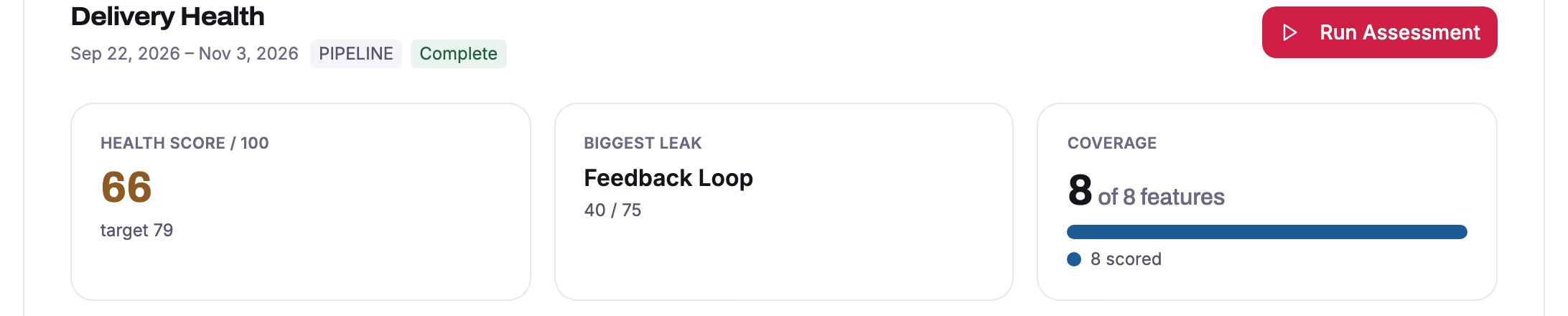
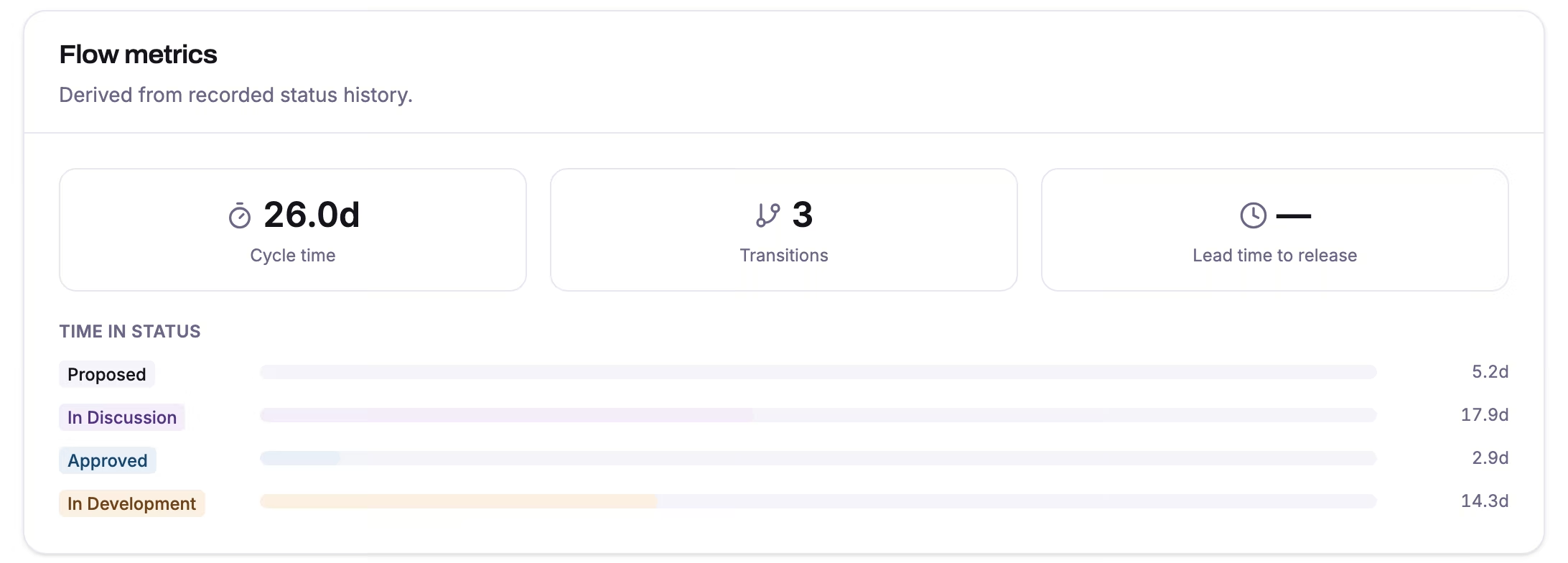
Delivery Health for the onboarding project: one score against its target, the biggest leak in the process, and how many features the assessment covers. Below it, for one feature, where its time went.
How Improve works
Consider a company working to improve customer onboarding.
During Align, the team agreed on a goal: help more customers complete onboarding successfully. During Run, developers used AI-supported execution to implement the agreed changes, then reviewed and verified the result.
The feature has now been released.
What happens next?
- 1
Review the intended outcome
The team returns to the original goal.
Did the onboarding changes produce the result the company wanted? Are there early signs of improvement? Is more information needed?
This keeps the discussion connected to the customer problem rather than ending when the feature is released.
- 2
Examine how the work was delivered
The team looks at the development process.
Implementation was relatively quick, but the feature spent several days waiting for clarification about a business rule. A similar delay occurred during an earlier onboarding change.
That pattern deserves attention.
- 3
Identify the underlying friction
Product and Engineering review why the business rule wasn't clear when execution began.
They discover that the rule had been discussed with Customer Success but wasn't connected to the original requirement.
The issue wasn't a lack of coding capacity. Relevant information wasn't available at the right moment.
- 4
Make an improvement
The team changes how business rules are captured and connected to product work during Align.
That gives future development tasks clearer context when they move into Run.
The team can then observe whether the change reduces similar delays.
Improve the system your developers work in.
When delivery performance falls short of expectations, organizations often look first at individual productivity. Are developers completing enough tasks? Are estimates accurate? Could the team work faster?
Those questions can overlook the conditions that shape performance.
A developer waiting for a product decision cannot resolve the delay by writing code faster. A team repeatedly revisiting unclear requirements may be working hard while making limited progress. And an AI coding agent can generate an implementation quickly without knowing whether the requirement behind it was complete.
Improve helps shift attention toward the development process itself.
For CEOs and Managing Directors
Understand how software delivery contributes to business priorities. See where organizational friction may be limiting the return on engineering and AI investments.
For CTOs and Engineering Leaders
Identify recurring delivery problems, evaluate changes to development workflows, and establish a more consistent approach to improving team performance.
For Product Leaders
Connect delivered work to product goals and understand where requirements, decisions, or dependencies affect execution.
For Software Teams
Discuss performance using shared information. Identify obstacles together and improve the conditions needed to deliver reliable software.
The purpose is to make better decisions about how the organization works, rather than turning performance measurement into individual surveillance.
Measure what matters as AI changes software development.
AI is changing how much implementation work a software team can complete. That makes traditional activity measures less informative on their own.
A team may generate more code, complete more tasks, or produce implementations faster without delivering proportionally more value to customers.
As implementation becomes easier, other constraints can become more visible.
Improve helps teams look beyond the volume of development activity. The important questions become:
- 1Are we delivering outcomes that matter to the business?
- 2Where does work spend time waiting?
- 3What causes repeated clarification or rework?
- 4Which changes to our process actually help?
- 5Are improvements sustainable as AI takes on more execution?
These questions connect engineering performance to the wider organization. They also give CEOs and CTOs a more useful basis for evaluating AI adoption.
The objective is to understand whether the entire software delivery system is improving.
Turn delivery experience into better decisions.
Many organizations already have the information needed to identify recurring problems. They know which features were delayed. They remember difficult releases. Developers can describe the requirements that caused repeated questions.
But those observations are often discussed in retrospectives and then separated from the work that follows. The same problems can reappear because the lessons never become part of the next planning and execution cycle.
Plenec connects Improve with Align and Run.
Insights from delivery can inform future priorities, requirements, responsibilities, and development practices.
This is how improvement becomes part of the operating process. The team learns from what happened and carries that understanding into what happens next.
One connected process: Align, Run, Improve.
Improve completes Plenec's connected approach to software team performance.
Agree on what matters.
Connect business goals, product priorities, requirements, and decisions.
Learn more →Turn decisions into execution.
Use shared context to guide AI-supported planning, implementation, review, and verification.
Learn more →Learn from delivery.
Understand effectiveness and efficiency, identify bottlenecks, and make informed improvements to how the team works.
You are hereThese activities form a continuous cycle.
Align provides direction. Run turns that direction into software. Improve helps the team understand the results and refine its approach.
The next development cycle begins with better information.
This is how Plenec helps established software organizations build high-performing, AI-native teams.
Frequently asked questions
What is Improve in Plenec?
Improve is the part of the Plenec platform that helps organizations understand software team performance, identify delivery bottlenecks, and support continuous improvement. It connects performance insights to the business goals and development activities managed through Align and Run.
What does Plenec mean by software team performance?
Plenec considers three dimensions: effectiveness, efficiency, and continuous improvement.
Effectiveness concerns whether the team delivers work that advances product and business goals. Efficiency concerns how smoothly work moves through development. Continuous improvement concerns the team's ability to learn and improve its working practices.
How is Improve different from a developer productivity dashboard?
Developer productivity dashboards often focus on activity measures such as completed tasks, code changes, or development throughput.
Improve takes a broader view by connecting development performance to product goals, delivery friction, and opportunities to improve the process.
Can Improve help identify software delivery bottlenecks?
Yes. Improve supports understanding where work slows down and where recurring problems affect delivery.
These may involve requirements, decisions, coordination, implementation, review, or verification.
The aim is to help teams identify causes and make informed changes.
How does Improve help companies evaluate AI adoption?
AI adoption should be assessed through its effect on software delivery and business outcomes, not simply by counting generated code or AI tool usage.
Improve helps organizations examine whether AI-supported development contributes to better delivery performance and where other constraints remain.
Is Improve intended to measure individual developer performance?
Improve focuses on software team performance and the development process.
Its purpose is to help organizations understand outcomes, identify friction, and improve working practices, rather than reduce performance to individual activity metrics.
How are Align, Run, and Improve connected?
Align establishes business and product direction. Run connects that direction to AI-supported execution. Improve helps teams evaluate delivery and use what they learn to refine future work.
Together, they create a continuous cycle of alignment, execution, and improvement.
Make every delivery an opportunity to improve.
Your team already generates valuable information through its daily work.
Improve helps turn that information into a clearer understanding of performance and better decisions about what to change.
Build a software organization that learns from execution and becomes more effective over time.
Build high-performing software teams.