From Conversation to Execution.
Turn product decisions into software, with AI handling more of the implementation and people staying in control.
Plenec connects product goals, requirements, decisions, and technical context to development execution. Teams can move from discussing what needs to be built to directing AI-supported implementation, reviewing results, and delivering reliable software.
The conversation was clear. What happened during implementation?
Most software features begin with people working through a problem together.
Product explains the customer need. Engineering raises technical constraints. The team discusses alternatives, resolves questions, and agrees on an approach.
Then the conversation ends.
Someone writes a specification. Someone else breaks it into tickets. Developers interpret those tickets and look for the information they need.
When something is missing, they ask questions. Decisions are repeated, documents are updated, and context moves between tools.
Eventually, the team has enough information to implement the feature.
AI coding agents can accelerate that implementation. But they still need to understand what the team has decided.
When an agent receives an incomplete task, it can produce an incomplete solution very quickly.
The challenge is to carry the understanding developed through human collaboration into software execution.
Keep product context connected to development.
Run connects the information behind product decisions with the work required to implement them.
Instead of relying on isolated tickets and repeated explanations, teams can use shared context to guide AI-supported execution.
Turn decisions into actionable work
Product discussions establish requirements, constraints, and priorities.
Run carries that information into the development process so implementation begins with a clearer understanding of what needs to be achieved.
Developers can work from the reasoning behind a decision, rather than reconstructing it from a short task description.
Give AI the context it needs
AI coding agents are capable of implementing substantial changes, but the quality of their output depends on the context and instructions they receive.
Run connects relevant product and technical information to execution, helping agents work within the team's intended direction.
The goal is to reduce the manual effort involved in preparing and repeatedly explaining development tasks.
Let developers direct execution
As AI takes on more implementation work, developers spend more time defining the approach, handling technical decisions, and evaluating results.
They remain responsible for understanding the system and determining whether an implementation is appropriate.
Run supports this way of working by connecting human decisions with AI-assisted development.
Review and verify the result
Generated code still needs to meet product requirements and engineering standards.
Run supports an execution process in which teams review the implementation, verify its behavior, and resolve issues before accepting the result.
AI can accelerate the work. Responsibility for the software remains with the team.
What this looks like in Plenec.
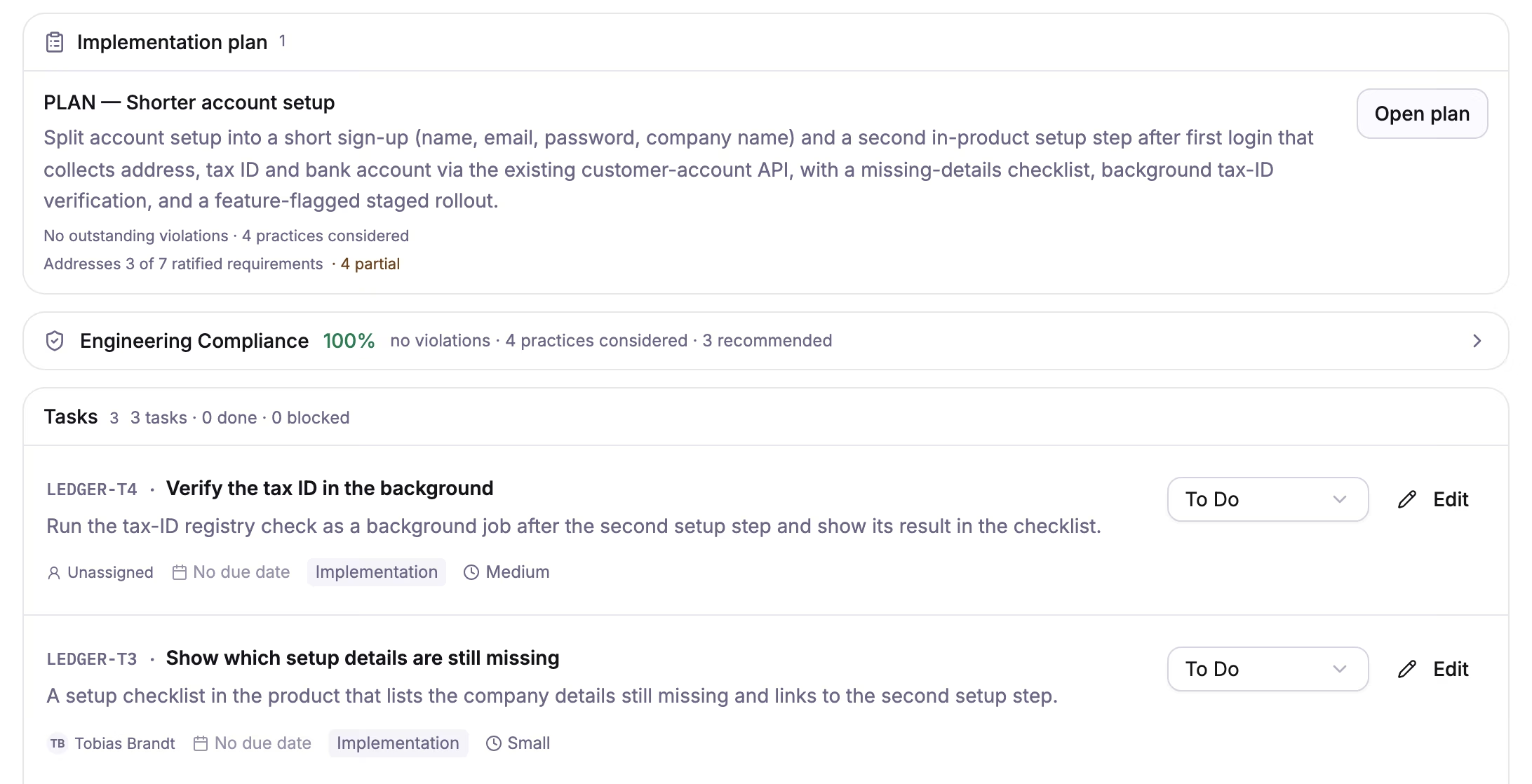
The same feature when it is being built: the implementation plan, checked against the agreed requirements and the team's engineering practices, and the tasks that carry it out.

How Run works
Consider a company improving its customer onboarding process.
During Align, Product and Engineering have agreed on a change intended to reduce onboarding abandonment. They have established the requirements, discussed technical constraints, and decided how to approach the problem.
The team is now ready to implement it.
- 1
Start with the agreed context
Run works from the product goal, requirements, decisions, and relevant technical information established during alignment.
The implementation is connected to the problem the team is trying to solve.
- 2
Prepare and direct execution
Developers establish the technical approach and guide the work.
AI can support the planning and implementation of the required changes, using the available context.
- 3
Implement with AI support
AI coding agents handle implementation tasks within the direction established by the team.
Developers can focus on architectural choices, constraints, and questions that require engineering judgment.
- 4
Review and verify
The team examines the implementation and verifies that it meets the agreed requirements.
Where changes are needed, developers can guide further execution.
Once the result meets the team's standards, it can proceed through the organization's delivery process.
Give developers more room to solve the right problems.
Writing code is only one part of software engineering.
Developers also need to understand complex systems, evaluate alternatives, anticipate risks, and make decisions that affect the long-term quality of a product.
As AI becomes more capable of implementation, those responsibilities become increasingly important.
Run helps teams organize development around that shift.
For developers
Spend less time translating isolated tasks into implementation details. Work with the context behind the feature, direct AI execution, and apply engineering judgment to the result.
For engineering leaders
Establish a more consistent approach to AI-supported development, with clear responsibilities for implementation, review, and verification.
For Product
Keep the reasoning behind requirements connected to development, reducing the need to repeatedly explain decisions as work progresses.
For the organization
Connect human collaboration more directly to software execution, reducing coordination effort without giving up accountability.
AI agents are part of the process. People remain responsible.
AI can write code, generate tests, and support other development activities.
That creates opportunities to change how software teams work.
But faster implementation also makes it easier to produce changes before the underlying requirements have been fully understood.
A technically valid implementation may still solve the wrong problem.
A change that passes automated tests may still conflict with a business rule or introduce an unacceptable product trade-off.
Developers need to understand what the software should accomplish and whether the result meets that expectation.
Run is built around this division of responsibilities.
Establish direction
Discuss problems, establish direction, and make important decisions.
Support execution
Implement within the direction the team has set.
Review and verify
Examine the result and decide whether it meets the expectation.
The process becomes more effective when these activities remain connected.
This is the thinking behind Plenec's approach to AI-native software development.
More human collaboration. Less manual coordination.
Build a connected Software Factory.
A coding agent can implement a task.
A Software Factory connects the broader activities required to deliver software reliably. That includes product direction, technical context, implementation, verification, and feedback.
Run is the execution layer within Plenec's connected operating model.
It uses the context established in Align to guide development work and provides the execution experience that informs Improve.
This connection matters because software development rarely follows a perfectly linear sequence.
What execution sends backWhen these activities remain connected, teams can resolve questions without repeatedly reconstructing the history of the work.
The result is a more coherent development process, with AI supporting execution and people responsible for the decisions that shape it.
Explore the Software Factory →One connected process: Align, Run, Improve.
Run is the execution part of Plenec's approach to building high-performing software teams.
Agree on what matters.
Connect business goals, product priorities, requirements, and decisions.
Learn more →Turn decisions into execution.
Use shared context to guide AI-assisted planning, implementation, review, and verification.
You are hereLearn from delivery.
Understand performance, identify bottlenecks, and improve how the team works.
Learn more →These activities form a continuous cycle.
Align provides direction for Run. Execution generates information about what works and where problems occur. Improve helps teams use that information to refine their process.
The objective is to make software delivery more effective as AI takes on a greater share of implementation.
Frequently asked questions
What is Run in Plenec?
Run is the part of the Plenec platform that connects product context with AI-supported software execution. It helps teams carry requirements, decisions, and technical information into development while retaining human responsibility for results.
Does Run replace software developers?
No. Run supports a development process in which AI handles more implementation work and developers direct, review, and verify the results. Engineering judgment remains essential for architecture, quality, security, and maintainability.
How does Run use the information from Align?
Align connects business goals, product priorities, requirements, and decisions. Run uses relevant context from that work to guide planning and implementation, helping developers and AI agents understand the purpose and constraints behind a feature.
Can AI coding agents work without human oversight?
AI agents can perform substantial implementation tasks, but their output still needs appropriate review and verification. Run supports human accountability for technical decisions and the quality of delivered software.
What is the difference between Run and an AI coding assistant?
An AI coding assistant primarily helps with implementation. Run connects implementation to the broader product and development context, including requirements, decisions, technical constraints, and verification.
How does Run relate to the Software Factory?
Run provides the execution part of Plenec's Software Factory approach. Align establishes direction, Run connects that direction to development, and Improve helps teams learn from execution and refine their process.
Turn shared understanding into working software.
Your team already invests time in understanding customer problems, evaluating solutions, and making product decisions.
Run helps carry that understanding into development, so AI can support more of the execution and people can focus on the decisions that matter.
From Conversation to Execution.